Leor Zmigrod
Dr Leor Zmigrod is a political neuroscientist and writer investigating why some brains are susceptible to extreme ideologies, how narrow beliefs shape our bodies, and how minds can break free from rigid dogmas.
Her first book, The Ideological Brain, is available now from Penguin Random House and Macmillan, alongside almost 20 translations. The book can be found at all major booksellers and independent bookstores, as well as in e-book and audio formats.
The Ideological Brain has been named one of the best books of 2025 by The Guardian, The Telegraph, The Los Angeles Times, New Scientist, Prospect Magazine, Behavioral Scientist, Next Big Idea Club, and Waterstones. It has also been longlisted for the 2025 Porchlight Business Book Award, the Non-Obvious Book Award, and Germany's 2025 Science Book of the Year.
Interviews, lectures, podcasts, articles, and readers' responses to The Ideological Brain can be found below. For updates on her latest work and ideas, follow Leor Zmigrod on Linktree, Instagram, LinkedIn, X/Twitter, Bluesky, or sign up to her mailing list.


Photo: Franck Ferville © Flammarion

THE IDEOLOGICAL BRAIN
The Ideological Brain is now available everywhere books are sold. It is also available on Audible, Spotify, GooglePlay, Kindle, and other e-book and audio formats.
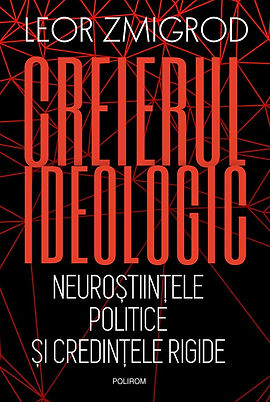
The book is also being translated into nearly 20 languages, including German, French, Italian, Spanish, Japanese, Korean, Portuguese, Ukrainian, Chinese, Arabic, Polish, Romanian, and more.
.png)


El cerebro ideológico
(Spanish)
Translated by Pedro Pacheco González.
Order The Ideological Brain in Spanish:

Das ideologische Gehirn (German)
Translated by Matthias Strobel.
Order The Ideological Brain in German:

Le cerveau idéologique
(French)
Translated by Christophe Jaquet.
Order The Ideological Brain in French:

O Cérebro Ideológico
(Portuguese)
Translated by Jorge Pereirinha Pires.
Order the book in Portuguese:

이데올로기 브레인
(Korean)
Translated by Kim A-rim.
Order The Ideological Brain in Korean:

המוח האידאולוגי
(Hebrew)
Translated by Ofer Kober.
Order The Ideological Brain in Hebrew:

BIOGRAPHY
Dr Leor Zmigrod is an award-winning scientist and author. Her research explores the psychology of ideological extremism using methods from experimental psychology, cognitive science, political science, and neuroscience. In particular, she investigates the cognitive, emotional, and neurobiological characteristics that might act as vulnerability factors for radicalization and ideological behaviour.
Leor completed her PhD as a Gates Scholar at the Department of Psychology, University of Cambridge. She was a Junior Research Fellow at Churchill College, Cambridge and has held visiting fellowships at Stanford University, Harvard University, the Paris Institute for Advanced Study and the Berlin Institute for Advanced Study.
Leor was listed on Forbes 30 Under 30 in the Science & Healthcare category, and received MHP's 30ToWatch in British Politics Gold Winner Award in the Unifier of the Year Category. She was awarded the ESCAN 2020 Young Investigator Award by the European Society for Cognitive and Affective Neuroscience and the Glushko Dissertation Prize in Cognitive Science by the Cognitive Science Society. Leor won the 2020 Women of the Future Science Award and the 2022 Women in Cognitive Science Emerging Leader Award, as well as the 2022 Distinguished Junior Scholar Award in Political Psychology by the American Political Science Association. Leor was also selected for the 2023 Falling Walls Female Science Talents Track and the UK Young Academy. She received a Student-Led Teaching Award by the University of Cambridge's Student Union.
Leor's research has been featured in The New York Times, The Guardian, TIME, New Scientist, Financial Times, The Times, amongst other international outlets.
Steven Pinker
"Filled with insightful findings, this book shows that ideological extremism and polarization are not just problems to fret about but puzzles that can be studied and understood."
Cass Sunstein
"An extraordinary, eye-opening, and startlingly original book, showing what ideology does to the human brain, and casting a bright new light on the sources and nature of dogmatism, ideology. and open-mindedness. Packed with insights, this is a remarkable achievement."
A.C. Grayling
"Fascinating, insightful, lucidly and entertainingly written, Zmigrod’s account illuminates the debate about the nature of ideology and the power it exerts... An educative, rewarding, troubling, but ultimately hopeful, book."
Nigel Warburton
"A fascinating and important exploration of why and how some people are drawn to authoritarian thinking while others are able to question and resist dominant ideologies."
Antonio Damasio
“The notion that political phenomena would somehow exist in a realm separate from that of human life regulation is pure fiction as Leor Zmigrod demonstrates so clearly. Her book is a must read.”
Adam Phillips
“This remarkable book tells us something fascinating and heartening about the neuroscience of our inflexibilities and our dogmatisms. Lucid and eloquent, The Ideological Brain couldn't be more timely.”
The New York Times
"Fascinating... Lively... Zmigrod is such an appealing writer."
The Sunday Times
"Massively important... Zmigrod is a joyful and compelling writer."
Financial Times
"A compelling look at the biological and environmental factors that foster dogma and intolerance.. Zmigrod’s thesis is fascinating."
VIDEOS AND TALKS
SELECTED PODCASTS
SELECTED INTERVIEWS


MEDIA


SPEAKING

Dr Zmigrod is a highly experienced and engaging speaker who enjoys presenting to diverse audiences, including public audiences, corporate leaders, policymakers, scientific and industry conferences, universities, schools, and literary workshops and events. She loves public engagement and has presented at TEDx, BBC Radio, the Hay Festival, and the United Nations. For a selection of topics, get in touch with Chartwell Speakers.

The Ideological Brain

Extremism in the 21st Century

The Science of Flexible Thinking
ACADEMIC PUBLICATIONS
-
Zmigrod, L.. & Kruglanski, A. (2025). Extremism and Ideology. In Conceptualizing Extreme Beliefs and Behaviors.
-
Zmigrod, L., Brandt, M.J., & Arceneaux, K. (2025). The Organization (and Disorganization) of Attitudes. In The Handbook of Innovations in Political Psychology.
-
Zmigrod, L. (2024). Ideological Mind-Shaping or Brain-Shaping: Fusing Empirical Biopolitics and Political Philosophy of Mind. Journal of Philosophy of Emotion. See paper here.
-
Gaffney, D., & Zmigrod, L. (2024). Historicising creativity: an interdisciplinary perspective between the social and natural sciences.
-
Németh, D., Vékony, T., Orosz, G., Sarnyai, Z., & Zmigrod, L. (2024). The interplay between subcortical and prefrontal brain structures in shaping ideological belief formation and updating. Current Opinion in Behavioral Sciences, 57. See paper here.
-
Iannello, P., Cancer, A., Zmigrod, L., Antonietti, A., & Salvi, C. (2024) Creative Minds in a Polarized World. The Journal of Creative Behavior. See paper here
-
Zmigrod, L., Burnell, R., & Hameleers, M. (2023). The Misinformation Receptivity Framework: Political Misinformation and Disinformation as Cognitive Bayesian Inference Problems. European Psychologist. See paper here.
-
Costello, TH., Zmigrod, L., Tasimi, A. (2023). Thinking outside the ballot box. Trends in Cognitive Science. See paper here.
-
Zmigrod, L. (2022). A Psychology of Ideology: Unpacking the Psychological Structure of Ideological Thinking. Perspectives on Psychological Science. See paper here and preprint here.
-
Zmigrod, L. (2022). Susceptibility to violent extremism and cognitive rigidity: Registered replication, corroboration and open questions for criminological research and practice. Legal and Criminological Psychology. See paper here.
-
Zmigrod, L., & Robbins, T.W. (2022). Dopamine, Cognitive Flexibility and IQ: Epistatic COMT:DRD2 Gene-Gene Interactions Modulate Mental Rigidity. Journal of Cognitive Neuroscience. See paper here and preprint here.
-
Zmigrod, L. (2022). Mental Computations of Ideological Choice and Conviction: The Utility of Integrating Psycho-Economics and Bayesian Models of Belief. Psychological Inquiry. 33:2, 107-116. See paper here or here, and preprint here.
-
Ramakrishnan, S., Robbins, T. W., & Zmigrod, L. (2022). Cognitive Rigidity, Habitual Tendencies, and Obsessive-Compulsive Symptoms: Individual Differences and Compensatory Interactions. Frontiers in Psychiatry. See paper here and preprint here.
-
Zmigrod, L., Eisenberg, I. W., Bissett, P., Robbins, T. W., & Poldrack, R.A. (2021). A Data-Driven Analysis of the Cognitive and Perceptual Attributes of Ideological Attitudes. Philosophical Transactions of the Royal Society B: Biological Sciences. See paper here and preprint here.
-
Zmigrod, L. & Goldenberg, A. (2021). Cognition and Emotion in Extreme Political Action: Individual Differences and Dynamic Interactions. Current Directions in Psychological Science. See paper here and preprint here.
-
Zmigrod, L. & Tsakiris, M. (2021). Computational and Neurocognitive Approaches to the Political Brain: Key Insights and Future Avenues for Political Neuroscience. Philosophical Transactions of the Royal Society B: Biological Sciences. See paper here.
-
Zmigrod, L. (2021). A Neurocognitive Model of Ideological Thinking. Politics and the Life Sciences. See paper here and preprint here.
-
Zmigrod, L., Ebert, T., Götz, F. M., & Rentfrow, P. J. (2021). The Psychological and Socio-Political Consequences of Infectious Diseases: Authoritarianism, Governance, and Nonzoonotic (Human-to-Human) Infection Transmission. Journal of Social and Political Psychology. See paper here and preprint here.
-
Zmigrod, L. (under review). Individual-Level Cognitive and Personality Predictors of Ideological Worldviews: The Psychological Profiles of Political, Nationalistic, Dogmatic, Religious, and Extreme Believers. See preprint here.
-
Ramakrishnan, S., Robbins, T.W., & Zmigrod, L. (2021). The Habitual Tendencies Questionnaire: A Tool for Psychometric Individual Differences Research. Personality and Mental Health. See paper here.
-
Zmigrod, L. (2020). The Role of Cognitive Rigidity in Political Ideologies: Theory, Evidence, and Future Directions. Current Opinion in Behavioral Sciences, 34, 34-39. See paper here.
-
Zmigrod, L., Rentfrow, P.J., & Robbins, T.W. (2020). The Partisan Mind: Is Extreme Political Partisanship Related to Cognitive Inflexibility? Journal of Experimental Psychology: General. 149(3), 407-418. See paper here and preprint here.
-
Rollwage, M., Zmigrod, L., De-Wit, L., Dolan, R.J., & Fleming, S.M. (2019). What Underlies Political Polarization? A Manifesto for Computational Political Psychology. Trends in Cognitive Sciences. See paper here.
-
Zmigrod, L., Rentfrow, P.J., & Robbins, T.W. (2019). Cognitive Inflexibility Predicts Extremist Attitudes. Frontiers in Psychology (Special Issue: Neural Perspectives on the Moral Psychology of Violent Conflict). 10, 989. See paper here.
-
Zmigrod, L., Zmigrod, S., Rentfrow, P. J., & Robbins, T. W. (2019). The Psychological Roots of Intellectual Humility: The Role of Intelligence and Cognitive Flexibility. Personality and Individual Differences, 141, 200-208. See paper here.
-
Zmigrod, L. (2019). Cognition and religiosity: Who is most likely to believe? Quarterly Journal of the Psychology Postgraduate Affairs Group (British Psychological Society), 111, 22-24. See paper here.
-
Ebert, T., Gotz, F. M., Obschonka, M., Zmigrod, L., & Rentfrow, P. J. (2019). Regional Variation in Courage and Entrepreneurship: The Contrasting Role of Courage for the Emergence and Survival of Start‐Ups in the US. Journal of Personality. See paper here.
-
Zmigrod, L., Rentfrow, P.J., & Robbins, T.W. (2018). Cognitive underpinnings of nationalistic ideology in the context of Brexit. Proceedings of the National Academy of Sciences, 201708960. See paper here.
-
Zmigrod, L., Rentfrow, P. J., Zmigrod, S., & Robbins, T. W. (2018). Cognitive flexibility and religious disbelief. Psychological Research, 1-11. See paper here.
-
Zmigrod, S., Zmigrod, L., & Hommel, B. (2018). The relevance of the irrelevant: Attentional distractor-response binding predicts performance in the Remote Associates Task. Psychology of Aesthetics, Creativity, and the Arts. See paper here.
-
Khalighinejad, N., Schurger, A., Desantis, A., Zmigrod, L., & Haggard, P. (2018). Precursor processes of human self-initiated action. NeuroImage, 165, 35-47. See paper here.
-
Zmigrod, L., Garrison, J. R., Carr, J., & Simons, J. S. (2016). The neural mechanisms of hallucinations: A quantitative meta-analysis of neuroimaging studies. Neuroscience & Biobehavioral Reviews, 69, 113-123. See paper here.
-
Zmigrod, L. & Zmigrod, S. (2016). On the Temporal Precision of Thought: Individual Differences in the Multisensory Temporal Binding Window Predict Performance on Verbal and Nonverbal Problem Solving Tasks. Multisensory Research, 29(8), 679-701. See paper here.
-
Zmigrod, S., Zmigrod, L., & Hommel, B. (2016). Transcranial direct current stimulation (tDCS) over the right dorsolateral prefrontal cortex affects stimulus conflict but not response conflict. Neuroscience, 322, 320-325. See paper here.
-
Zmigrod, S. & Zmigrod, L. (2015). Zapping the gap: Reducing the multisensory temporal binding window by means of transcranial direct current stimulation (tDCS). Consciousness and Cognition, 35, 143-149. See paper here.
-
Zmigrod, S., Zmigrod, L., & Hommel, B. (2015). Zooming into creativity: Individual differences in attentional global-local biases are linked to creative thinking. Frontiers in Psychology, 6:1647. See paper here.
CONTACT
FOLLOW
Website
Mailing List
GoogleScholar
Twitter / X


